

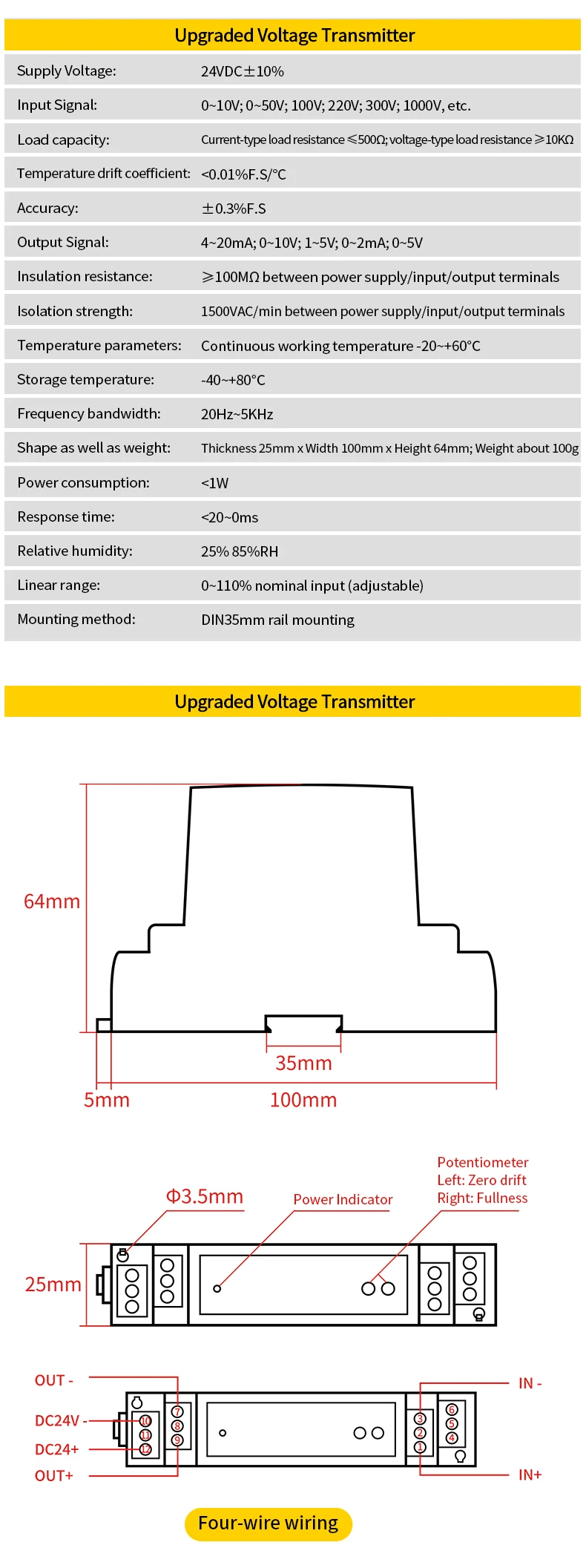
Voltage Transducer 0-100V 0-200V 0-300V Voltage Transmitter 4-20mA 0-10V 0-5V RS485 Voltage Sensor AC Voltage Signal Transmitter
QD-21U / Output 0-10V / China Mainland|DC24V|DC 0-1500V
$151.11
Sale price
$151.11
Regular price
$0.00
Skip to product information


Voltage Transducer 0-100V 0-200V 0-300V Voltage Transmitter 4-20mA 0-10V 0-5V RS485 Voltage Sensor AC Voltage Signal Transmitter
$151.11
Sale price
$151.11
Regular price
$0.00
Description
SPECIFICATIONS
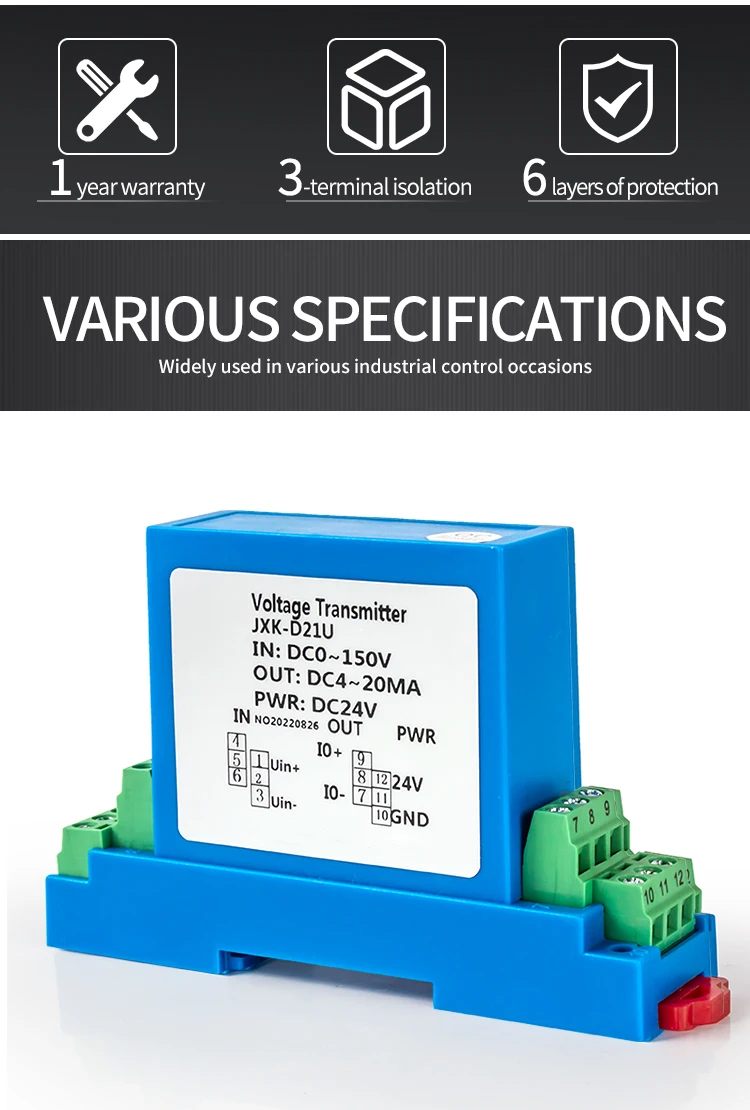
1: AC Voltage Sensor
2: DC Voltage Sensor
3: AC Voltage Transducer
4: DC Voltage Transducer
5: AC Voltage Transmitter
6: DC Voltage Transmitter
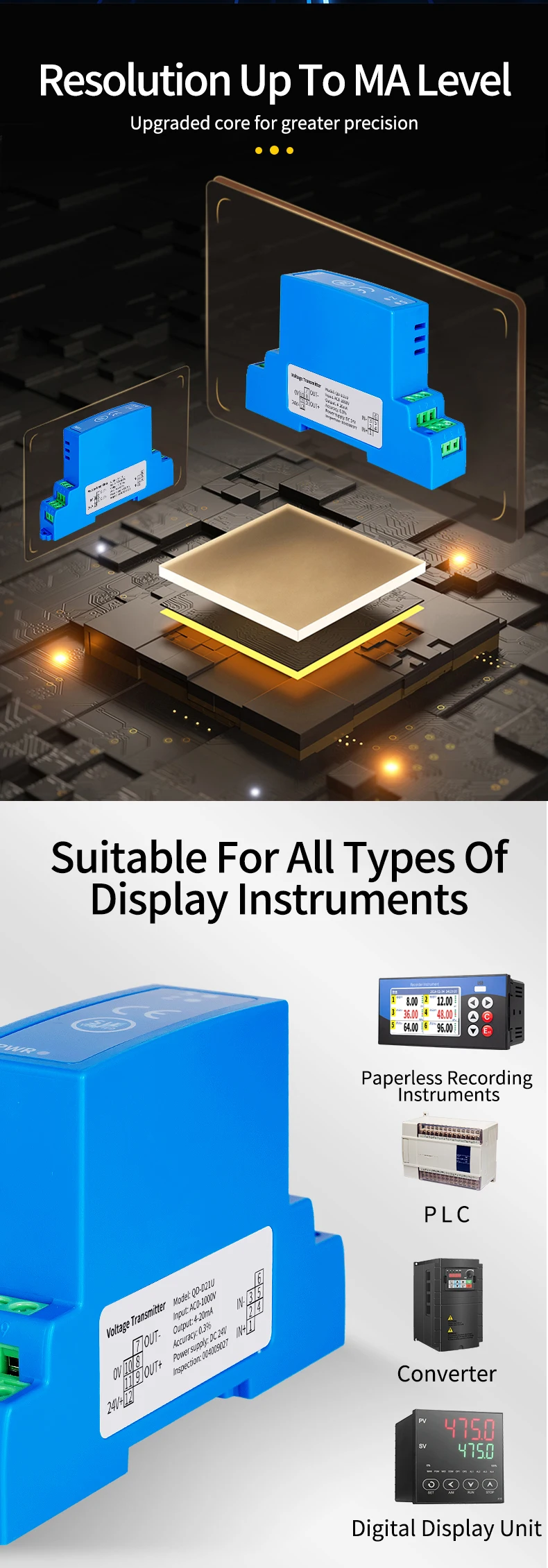
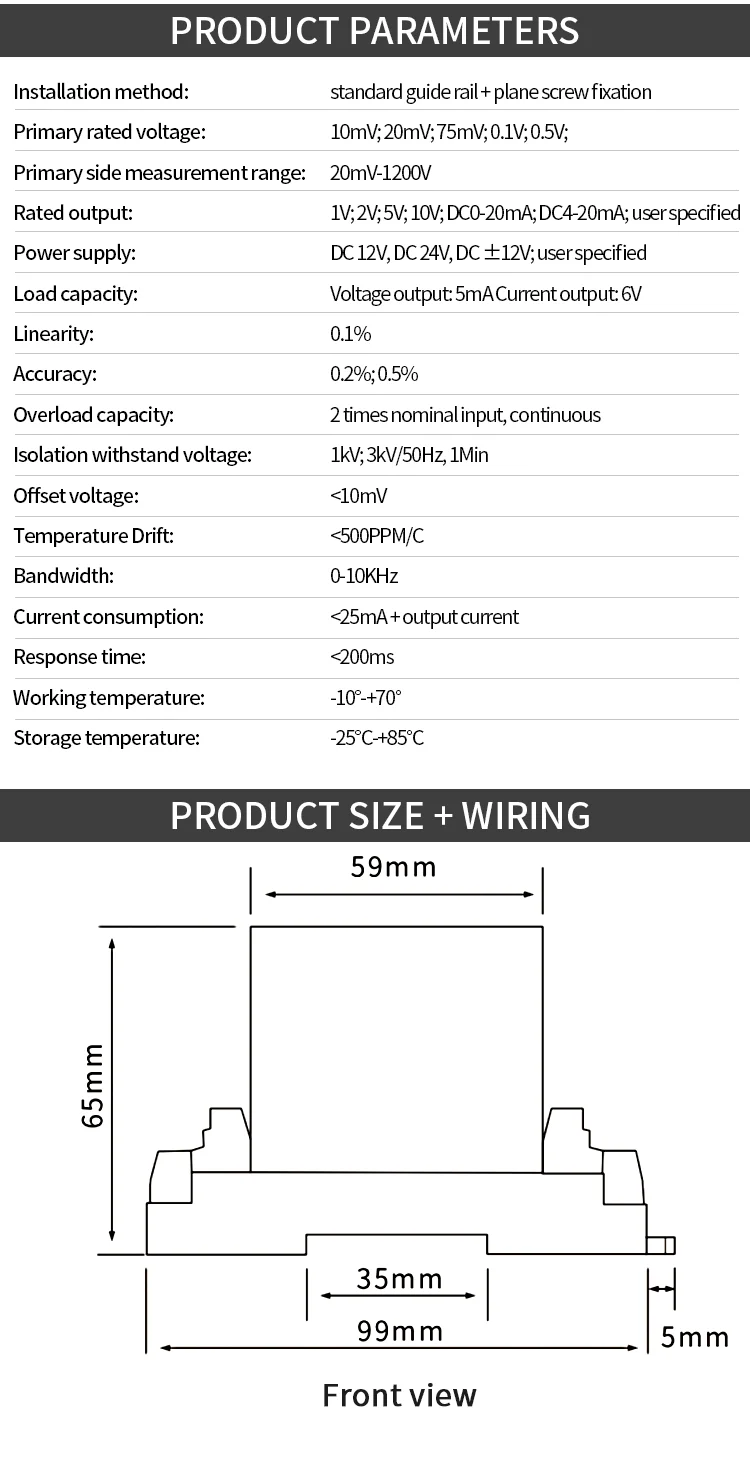
Accuracy Class: 0.3%
Battery Included: no
Brand Name: Vadias
Certification: CE,FCC,RoHS
Choice: yes
DIY Supplies: Electrical
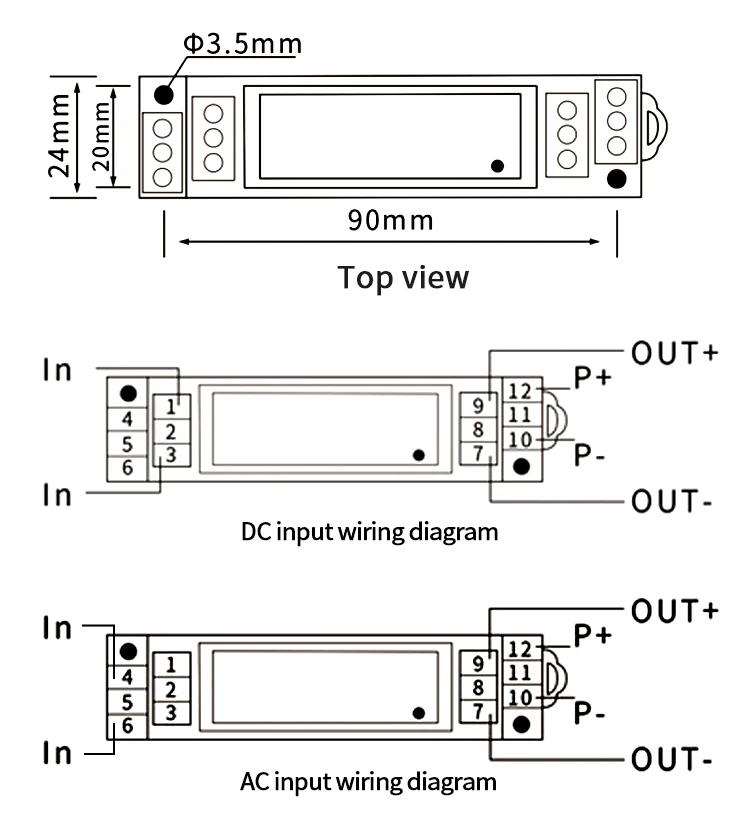
Dimensions: 13*12*3
Display Type: Analog-Digital
High-concerned chemical: none
Model Number: QD-21U JXK-21U
Operating Temperature: -40-60℃
Origin: Mainland China
Output Signal: 4-20mA 0-10V 0-5V RS485
Power: DC24V
Power Source: DC24V
Power Supply: DC24v
Product: AC DC Voltage Sensor Transducer Transmitter
Range: AC/DC 0-1000V
Semi-finishedproduct: No
Voltage range: 12/48-1000V AC
semi_Choice: yes
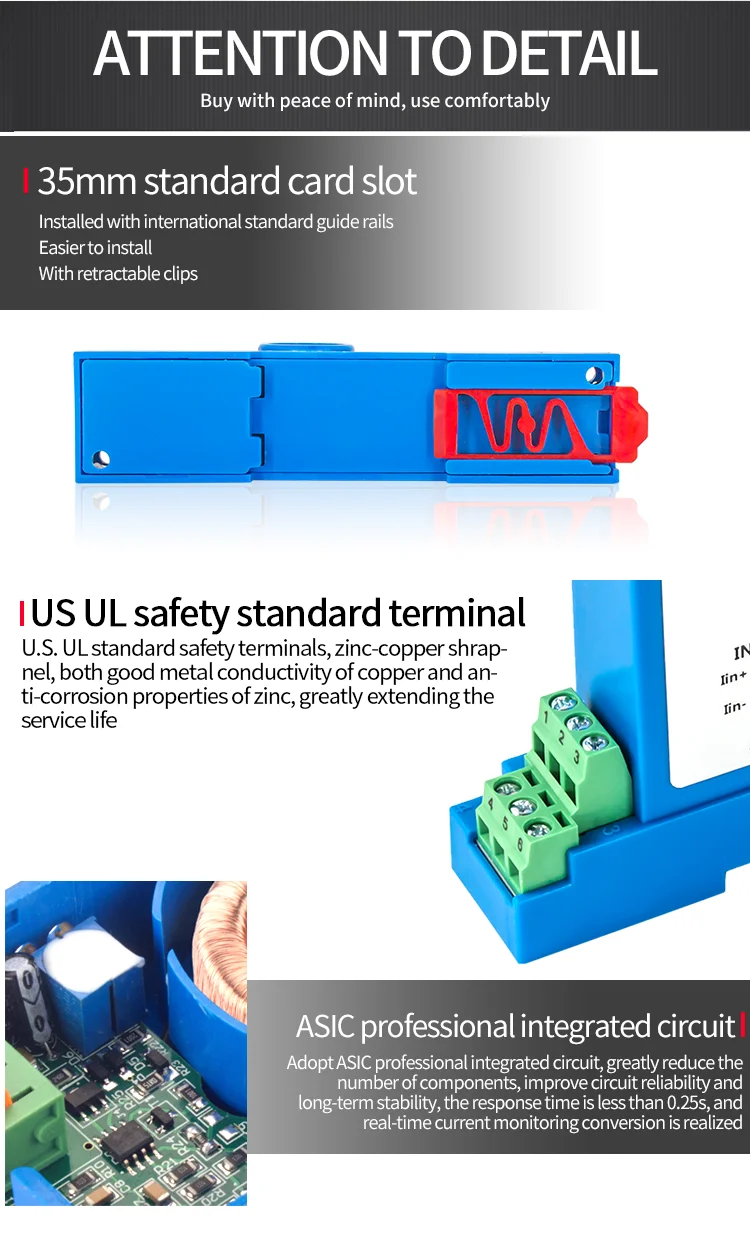
In AC/DC voltage transmitters, "isolation" refers to the electrical separation of different circuit sections to prevent direct current flow between them. The primary purposes of isolation include:
1. Safety: To prevent hazardous voltages from the high-voltage side (input) from affecting the low-voltage side (output or power supply), thereby protecting both personnel and equipment.
2. Elimination of ground loops: When multiple grounding points exist within a system and potential differences occur between them, interference currents (ground loop currents) can be generated. Isolation interrupts this current path, thereby eliminating associated measurement errors such as noise and offset.
3. Enhanced immunity to common-mode interference: Isolation suppresses high-voltage interference (common-mode voltage) that appears simultaneously at both input (or output) terminals relative to the reference ground.
4. Level conversion: Facilitates signal transmission between circuits operating at different reference potentials.
The fundamental distinction between two-terminal isolation and three-terminal isolation lies in the number of isolated circuits and the resulting number of isolation barriers.
Two-Way Isolation / Input-Output Isolation
Structure: A single isolation barrier is established between the input and output circuits. The power supply circuit typically remains non-isolated and may share a common reference point with the output circuit (usually the negative terminal of the DC power supply or 0V). There is isolation between the input positive and negative terminals and the output positive and negative terminals. However, the output negative and power supply negative are generally connected together (common ground).
Features:
- Relatively lower cost.
- Simpler structural design.
- Effectively isolates the influence of high input voltage on the low-voltage output side.
- Capable of eliminating ground loops between the input and output sides, provided the output side does not have independent grounding issues differing from the power supply ground.
Applicable scenarios:
- When dangerous high voltage exists on the input side and the low-voltage output must be isolated from operators.
- When the input and output operate at different potentials, but the power supply and output can share a single, stable grounding point (e.g., located within the same control cabinet and using the same power source).
- Applications where cost considerations are significant and complex grounding loop problems are absent.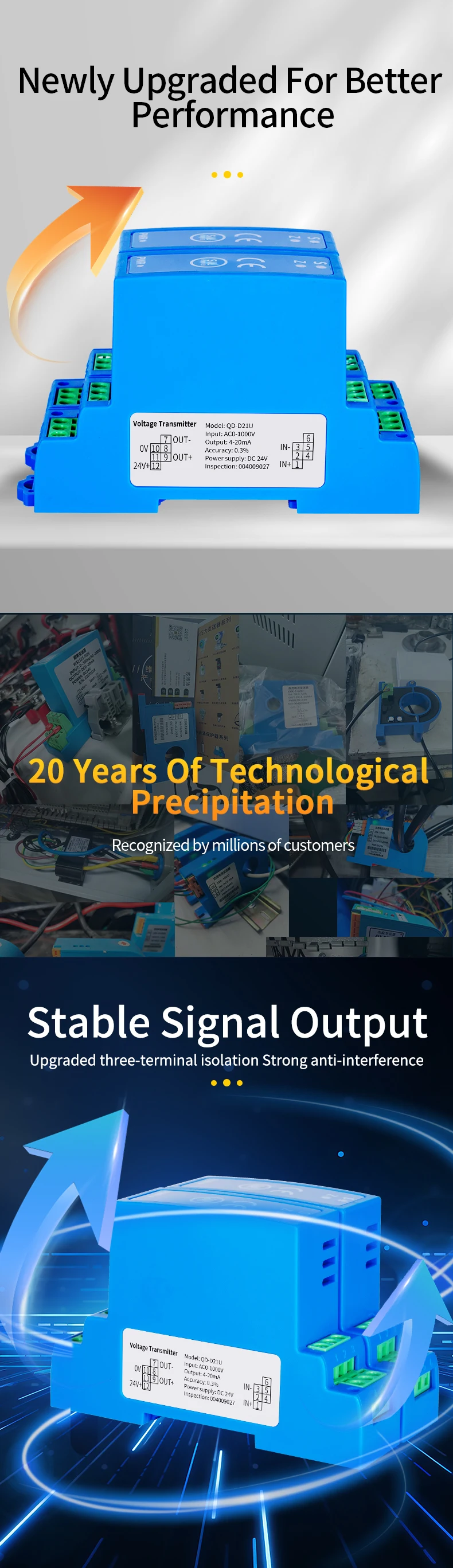
Three-Way Isolation / Triple Isolation / Input-Output-Power Isolation
Structure: Independent isolation barriers are established among the input circuit, output circuit, and power supply circuit. These three components are entirely electrically independent. Three distinct isolation barriers exist: input-output, input-power supply, and output-power supply. The input, output, and power supply are completely "floating," with no direct electrical connection.
Features:
- Provides the highest level of isolation safety.
- Fully eliminates ground loops: Since the input, output, and power supply are mutually independent, potential differences cannot generate interference current loops.
- Superior resistance to common-mode interference: The reference potentials of the input, output, and power supply can vary significantly and fluctuate independently, yet the transmitter maintains normal operation.
- Higher cost and more complex structure compared to two-terminal isolation.
Applicable scenarios:
- Critical safety applications: Where the input side is exposed to extremely high voltages or hazardous environments, and both the output and power supply sides must be fully isolated from the input.
- Complex grounding environments: When input devices, output devices (such as PLCs, DCSs, recorders), and the power supply are located in separate physical areas, each with its own grounding point, and there are notable potential differences between these grounds (e.g., large factories, power plants, substations).
- High common-mode voltage conditions: When the potentials at both ends of the input signal relative to the transmitter's installation ground are very high and potentially fluctuating. Applications requiring maximum measurement accuracy and stability while avoiding any possible grounding interference, such as medical equipment and other fields with stringent isolation requirements.
Selection Criteria:
- Prioritize three-terminal isolation when the field environment is complex (with distributed equipment, unclear grounding conditions, or potential differences), when extremely high safety and measurement accuracy are required, or when budget allows.
- Two-terminal isolation may suffice when the application scenario is well-defined, the input requires safe isolation, and the power supply and output devices are co-located with a shared, reliable single ground, without significant ground loop concerns, especially when cost is a key consideration.
In summary, three-terminal isolation offers the most comprehensive and flexible electrical isolation solution, ensuring complete independence among the input, output, and power supply, and eliminating mutual influence due to differing reference ground potentials. In contrast, two-terminal isolation primarily addresses the isolation between input and output, while the reference points of the power supply and output (and sometimes even the input) may remain interconnected. In industrial settings characterized by multi-point grounding or complex electromagnetic environments, three-terminal isolation is generally the more reliable option.
Free Shipping Over $199
- Standard Shipping: Standard Shipping (12–18 Business Days)
- Express Shipping: Expedited Shipping (5–9 Business Days)
- Free Shipping: Orders over $199 qualify automatically
- Tracking: Full tracking number provided for all orders
30-Day Return Policy
- Returns: 30-day hassle-free return window
- Condition: Items must be unused and in original packaging
- Refund: Full refund processed within 3-5 business days
Why Choose Us?
- Factory Direct: ISO/TS 16949 certified manufacturer
- Quality: 100% electrical continuity tested before shipment
- Experience: 15+ years in automotive connector industry
- Support: Professional technical support available

You may also like
Blog posts
Title
An excerpt of your blog post's content
Title
Date|Author
Subscribe to our emails
Be the first to know about new collections and special offers.